Telephone Hybrids - HY-03 - Series (Analogue)
 |
||
 |
 |
|
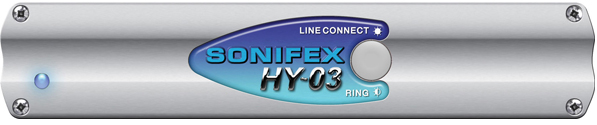
Front View |
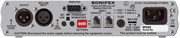
Rear View |
|
HY-03 Telephone Hybrid.
HY-03 Telephone Hybrid
 The analogue HY-03 telephone hybrid is the replacement for the HY-02, which for many years has set the standard as an excellent value, high quality telephone hybrid.
The HY-03 retains many of the features of the HY-02 and adds some additional ones. Some of the features of the HY-03 include :
- Fully automatic - adapts to varying line conditions and has automatic signal limiting.
- Local and remote line hold switching - calls can be remotely switched through a mixing console.
- Momentary or permanent latching remotes can be enabled.
- Balanced mic/line input - 10k ohm balanced input selectable for 0dBu clean feed line, or microphone level with adjustable gain.
- Balanced output - 0dBu low impedance balanced output, with output gain adjustment.
- Mixed output - the output can be a mix of the caller and mic/line input signals for recording both sides of the telephone conversation.
- Integrated ring detector - automatic call answering after a pre-determined number of rings.
- Fitted with K-break disconnect detection as standard with an option for dial-tone disconnect using the optional HY-03DTD board. The HY-03DTD board can be configured to disconnect on recognizing the dial tone used in a specific country.
- Line limiter, bandpass filter and output noise gate with preset threshold providing low distortion crystal clear audio.
- 28dB typical line balance rejection.
- Built in power supply with switchable 115V, or 230V, mains input.
- BABT approval compliant with European PTT specifications.
Which Format Is Most Suitable?
The HY-03 analogue hybrids are available in three models :
- HY-03 Single free-standing automatic analogue TBU.
- HY-03S Single 19” rack mounted automatic analogue TBU with ringing detector.
- HY-03T Twin 19” rack mounted automatic analogue TBU.
What The Press Said:
The Guardian, February 2012 >